Virtual Lecture
Marine Aviation as a Fleet Air Arm in the Pacific War, 1941–1945
On Thursday 18 June 2026 at 6pm, Dr Peter F. Owen will consider the role of marine aviation as a fleet air arm during the Pacific War. This lecture will be hosted virtually via Crowdcast.
Talk Outline
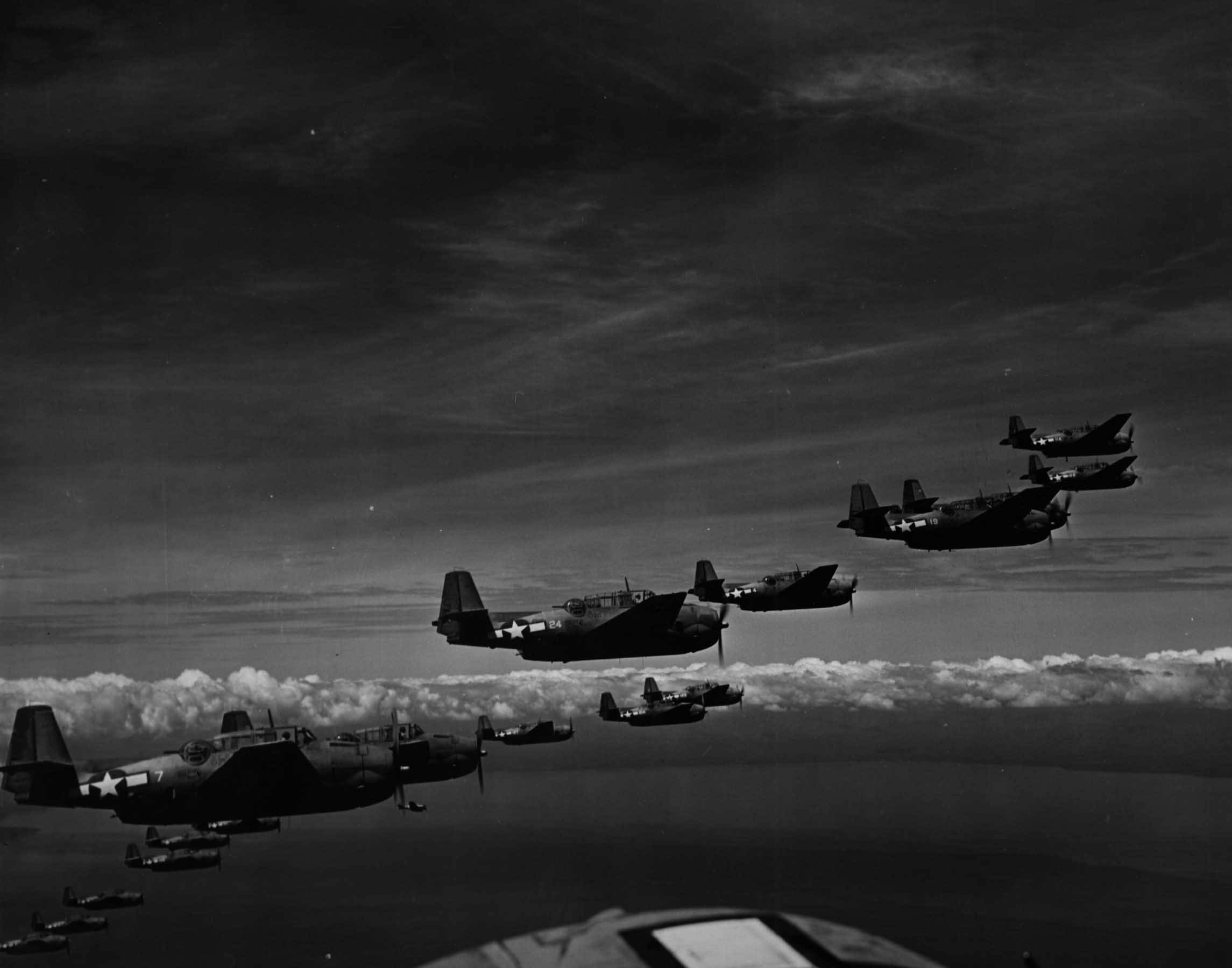
For the past century, the U.S. Marine Corps has consistently declared that the purpose of its aircraft has been to support its marines ashore. But the ninety-eight squadrons the Marine Corps deployed to the Pacific between 1941 and 1945 overwhelmingly supported the fleet at sea, not the landing force ashore. This paper will argue that the role marine aviation fulfilled in the Pacific War was to protect the fleet’s ships and bases and strike enemy vessels and installations to help the fleet achieve sea control. The paper will explain why marine aviation rarely supported marines ashore and why it was more suited to supporting the fleet instead.
This paper will also examine the effectiveness of marine aviation in this role by scrutinizing one squadron: VMF-221, the Fighting Falcons. This fighting squadron was destroyed at Midway in 1942, wore down Japanese air strength in the Solomons in 1943, and defended the fleet from suicide attacks while aboard the aircraft carrier USS Bunker Hill (CV-17) in 1945. The paper will examine the effectiveness of VMF-221 in each of these campaigns, revealing that the squadron achieved mixed results supporting the fleet, but its effectiveness matured across four years of fighting.
This aspect of Marine Corps history is relevant to the future direction of aviation in the U.S. Marine Corps. In 2018, the Commandant of the U.S. Marine Corps announced a dramatic change in the service’s role: “Marines will focus on exploiting positional advantage and defending key maritime terrain that enables persistent sea control and denial operations forward.” Rather than conducting amphibious assaults, responding to crises, and fighting small wars, in the mid-21st century the Marine Corps will fight as part of the U.S. fleet to gain and maintain air superiority and sea control. As marine aviation returns to fight in support of the fleet, a deeper understanding of its historic role as a fleet air arm may prove informative.
Livestream
To attend virtually, register via Crowdcast.
About Dr Peter F. Owen, Lieutenant Colonel, USMC (Retired)
Peter Owen earned a doctorate in war studies at the Royal Military College of Canada in Kingston, Ontario. His research concentrates on the U.S. Marine Corps and the World Wars. His dissertation was “US Marine Corps Aviation in the Second World War: It’s Effectiveness in Support of the Pacific Fleet.”
Peter served as a Marine Corps infantry officer for over twenty years. He has taught professional military education as an adjunct faculty for the Marine Corps University since 2004. Peter now works in central New York for the U.S. government as a security specialist in the Cybersecurity and Infrastructure Security Agency.