Virtual Lecture
35 years since Desert Storm: Saddam, AI, and the future of Air Warfare
On Thursday 26 November 2026 at 6pm, Ioannis Sidiropoulos will reconsider the Gulf War’s impact in the modern world. This lecture will be hosted virtually via Crowdcast.
Talk Outline
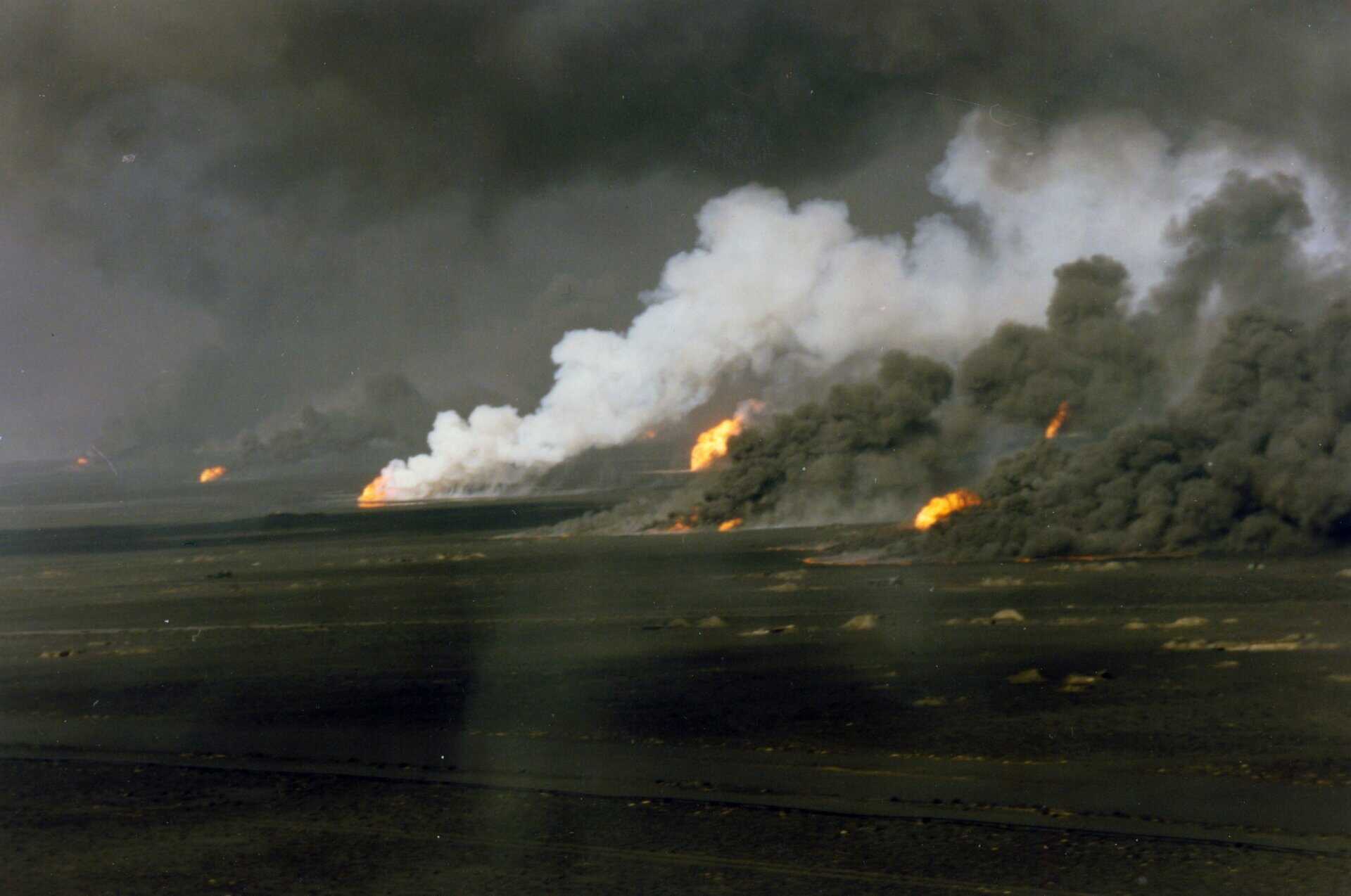
As we mark 35 years since Operation Desert Storm in 2026, this lecture reconsiders the Gulf War not just as a historical inflection point for air power; but as an early harbinger of the dilemmas AI-driven warfare now poses. In 1991, Saddam Hussein’s regime offered Western militaries a concentrated “target ecosystem,” allowing for the debut of precision-guided munitions, networked reconnaissance, and real-time strike coordination at scale. These capabilities, then analogue and human-directed, foreshadowed today’s algorithmic battlespace, where AI-enabled sensor fusion, target recognition, and decision support systems increasingly automate the kill chain.
This lecture explores what Desert Storm unwittingly inaugurated: a geopolitical and ethical trajectory toward the normalization of automated air power, raising urgent questions now confronting NATO allies. Drawing on current U.S. AI military doctrine and the 2026 Pentagon strategy for AI-first warfare, it contrasts the United States’ deregulatory and accelerationist paradigm with the EU’s risk-averse, rights-centric approach, embodied in the AI Act and the Council of Europe’s AI Convention.
Using Desert Storm as a conceptual baseline, the presentation examines how a permissive battlespace shaped Western attitudes toward air power automation—and how this legacy may clash with emerging European legal frameworks that exclude military AI from direct regulation, yet increasingly influence dual-use AI norms.
The lecture offers a European legal and strategic perspective on the challenge of aligning rapid AI military integration with foundational principles of accountability, proportionality, and democratic oversight. It argues that what Saddam “offered” to the AI age was not just a battlefield, but a governance void; one that persists in current transatlantic approaches to defence AI. Bridging that void will be essential to ensuring that the next AI-enabled air campaigns remain compatible with both strategic interoperability and international legal standards.
Livestream
To attend virtually, register via Crowdcast.
About Ioannis Sidiropoulos
Ioannis Sidiropoulos is a lawyer qualified in Greece and Cyprus, and a PhD candidate focusing on AI governance in national security. He studied at the London School of Economics, the University of Amsterdam, and the University of Nicosia, and also holds a certification in the History of Economic Thought from the University of Oxford.
Alongside his legal career, which includes experience in prominent law firms, Ioannis has worked as a research assistant on a major program at the European Law Institute and has held research and teaching roles with institutions including Leiden University, the Diplomatic Academy of the University of Nicosia, and the Cyprus Business School. He also has experience in geopolitical advisory as a Senior Fellow at the Strategy International Think Tank in Cyprus. His research interests include history, international economic relations, arms procurement, and civil and military aviation, and he has published extensively in domestic and international newspapers and journals. He speaks Greek, English, German, and French.